
Local ≠ small brand impact
What founders can learn from SecureBio about reaching real customers through local coverage

Not once has a founder approached me asking how to build a local communications strategy.
Meaning: there’s no longing to land coverage in local newspapers, magazines, or blogs—or to pitch local broadcast on a behind-the-scenes look at, well, anything.
That’s a missed opportunity. Don’t assume local press is too small to matter.
Depending on your target audience, landing in the Tampa Bay Times, The Boston Globe, or The Seattle Times can be your fastest path to brand awareness with a hard-to-reach audience.
If you’re trying to reach small business owners, non-technical professionals, educators, or an older demographic, local press shouldn’t be an afterthought.
(If you need proof, look at where many of tech’s most visible investors now spend their attention: local politics and local publications.)
In tech, we tend to over-rotate on the idea that startups are mostly building for other startups—think early days of Deel, Fondo, or Brex. (Or maybe that’s just me after spending six years at Y Combinator.)
We also over-rotate on the belief that startups are primarily building for technical users—likely because that’s who dominates X, subreddits, and Hacker News.
But there’s an entire world of founders building for people who consume local content. Carta’s 2025 State of Startups report was a reminder of just how broad that world really is.1

Look at all of those industries. Founders aren’t just building for other founders and developers.
So how do you reach HR leaders and financial managers at small and mid-sized businesses across the country? What about restaurant owners, food truck operators, brick-and-mortar retailers, or pop-up shop founders?
Local ≠ small brand impact.
Many local publications punch far above their weight on social—especially Facebook, which still reaches these audiences (or, at the very least, their parents, who might print out the Facebook post and give it to your target audience). Facebook rewards community-driven stories, and local business coverage benefits from geographic network effects: people share what feels personal.
A single local hit can create outsized brand recognition. I executed this strategy repeatedly at Square to reach small business owners—long before we were a public company.
Highlight the users’ stories, not yours
There’s a hack to local press: clearly show how your product is already impacting people locally—and tell that story through a local resident.
At Square, I’d start with data. I looked at where we were seeing the highest usage, then ranked the top 25 cities by population. (I wanted to land coverage in the largest cities early to reach the most small business owners.) From there, I had a clear stack rank of cities to focus on.
Then I talked to customers in those cities. I looked for highly active sellers running ideal businesses for us—coffee shops, brick-and-mortar retailers, food trucks, farmers market vendors, pop-ups. I cold-emailed them, and most were eager to talk.
I spent hours hearing stories about how Square changed the way they accepted payments—often preventing missed sales entirely. Many had numbers to back it up.
Once I had compelling local stories, I built a list of local publications and started pitching—beginning with the outlet with the largest reach.
I never pitched a story about “new technology being used in Ann Arbor.” Instead, I pitched the story of a local gelato shop—founded by someone who wanted to share a piece of their culture with the community. And to do that, they used a new tool that turned an iPad into a cash register.
In interviews, they would naturally talk about how expensive traditional POS systems were—and how much customers loved using Square.
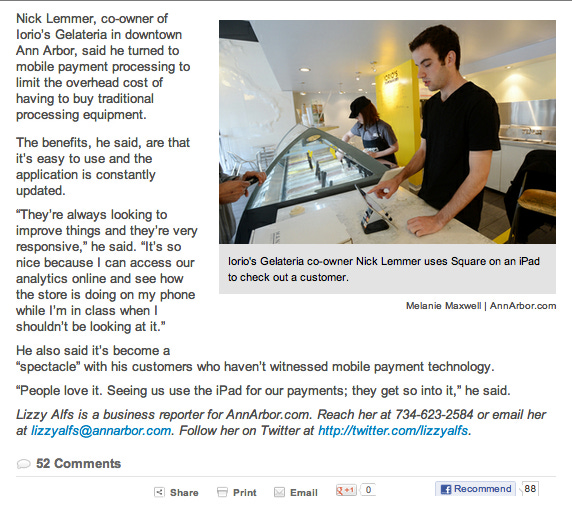
Small business owners never said no to me pitching their story. It was mutually beneficial: Square gained local awareness, and the business gained local visibility. Win-win.
As a founder, this is how you land local coverage. You talk to your customers. You listen to their stories. And you pitch their story to highlight your own.
Local-first storytelling
SecureBio functions like a startup, but is actually a nonprofit.2
The company is best known for searching through sewage to monitor the spread of disease—regularly testing water of 20 US cities.
Even though SecureBio is headquartered in Cambridge, it still needed local proof points to get covered in The Boston Globe.

Here are three ways SecureBio anchored recent coverage in local impact:
SecureBio invited the reporter to a behind-the-scenes activation in front of Boston’s Old South Church, where two employees asked passersby to swab their noses. This immediately grounded the story in a specific place in Boston.
The reporter had direct access to the local technical manager running the project, as well as the two employees running the activation, including one with a deeper Boston tie as a student at Boston University. These details made the work feel embedded in the community, not a lab.
SecureBio let locals speak for themselves. The reporter interviewed participants who volunteered their noses for science, asking why they chose to take part. Their motivations became part of the story.
The story is filled with local connections. (The timing helped too: published just before Christmas when many families were isolating due to COVID and Flu B.)
Now, let’s further break down why this worked, so you can replicate it.
The reporter
Finding the right reporter starts with finding the right outlet.
I usually begin with a simple Google search: “top news publications in [city]”.
If the story has a strong visual component, I’ll also search “top local TV stations in [city].” (SecureBio’s activation, for example, would have been a strong fit for local broadcast.)
If your goal is to hire locally—meaning your target audience is candidates—search for “startup blogs in [city]” or “startup media outlets in [city].” Locals in the tech ecosystem often follow these publications closely, especially on social.
Once you’ve identified an outlet, go to the business section and look for a technology, startup, or innovation beat. In most local newsrooms, one name will surface repeatedly—local teams are small, and beats are clearly defined.
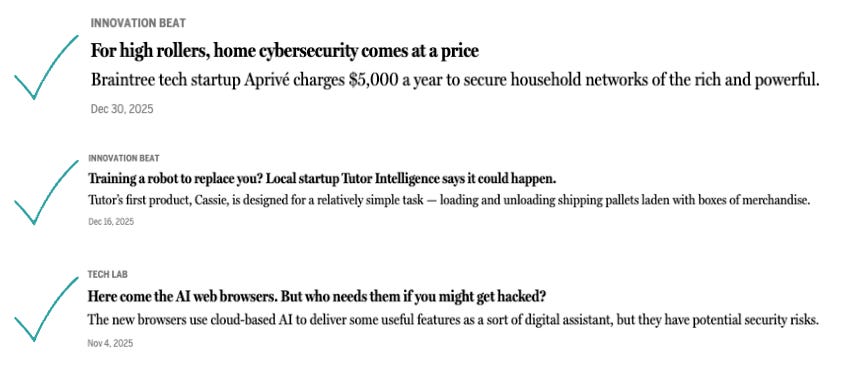
For The Boston Globe, that reporter is Hiawatha Bray.

Hiawatha is a technology writer in the Business section and a frequent contributor to the Globe’s Innovation Beat newsletter.
His bio shows he’s spent more than 30 years covering technology, including the rise of the internet, social media, and Apple’s iMac and iPhone. He has seen firsthand how technology reshapes culture and local economies—context that’s especially valuable when covering startups today.
That background alone would push me to pitch him on a story about how a startup is impacting Boston’s economy or community.
That said, you should always read a reporter’s recent coverage before pitching.
For example, there are reporters in Cincinnati with similar experience who now exclusively cover innovation inside public companies like Procter & Gamble or Kroger. Despite the overlap in background, they would not be the right fit for a startup pitch.
Hiawatha, by contrast, regularly covers local startups—meeting founders, visiting offices, testing new products, and reporting on how new companies show up in everyday life.
The story
A reminder of the questions to find your angle:
What’s the news hook?
What cultural shift does this reflect?
What trending story can you plug into?
What about your founder story or background is unique?
Do you have a partnership with a recognizable company?
Do you have surprising growth or customer data that gives a new perspective on the market?
Do you have investors with strong name recognition?
This framework works well for national coverage. But when you apply it to local press, like SecureBio’s story in The Boston Globe, something doesn’t work.
News hooks: Scientists were stationed in front of Boston’s Old South Church asking passersby to swab their noses—for science. The swabs were collected only in Boston. If the method proves effective, it could become part of a nationwide early-warning system for future pandemics.
Cultural shift: The pandemic fundamentally changed how we think about public health. SecureBio exists because of that shift—and because of the collective desire to catch the next outbreak earlier.
Trending story: As of this month, flu-like illness activity now at highest rate on record, according to the CDC. SecureBio’s tests track the ebb and flow of viruses in the local population.
FounderEmployee background: The reporter had direct access to the three local employees running the project and activation.Partnerships: Not relevant here.
Data: SecureBio paid out roughly $20,000 in swab incentives and collected more than 10,000 samples—all locally.
Investors: Not relevant here.
There isn’t a traditional news hook or strong data, yet, on the results of the local study. But it still works, because local stories don’t require conclusions but relevance. You need:
Data that’s specific to the city;
Physical presence in the city;
A visible impact on people who live there;
And, most importantly, you need human elements.
You see this in the Globe’s coverage when the reporter digs into the scientists themselves—where they’re from, what they studied, what drew them to this work. One was born and educated in Switzerland; another is studying genetics at Boston University; and another graduated from Dartmouth and is interested in microbial ecology.
You also see it in the voices of the people on the street.
Brittany Bernie was doing her bit to protect public health. “I did this to stop the germs and the whole spread of everything and make sure we’re all safe,” she said. The money played no part in her decision.
The same went for another woman, Alex Million. “ I think it’s important to detect the next pandemic,” she said. “To protect people and get the vaccine.”
But for Eric Saarinen, the price was right. “I was walking by and they asked … you need a $2 bill?” Saarinen said.
Local coverage is an entirely different game. You need locals in the interviews. You need the impact to be tangible. And it helps if the story literally unfolds in the middle of the city—like on the steps of Boston’s Old South Church.
Local reporters don’t need proof your company matters to the world. They need proof it matters to their city.
The pitch
SecureBio is headquartered in Cambridge, which means the team operates in the same ecosystem as The Boston Globe.
Founders: Invest time building relationships with local reporters, especially if you’re outside of the Bay Area and New York. Local tech ecosystems are smaller, and reporters are often eager to understand how innovation is showing up in their city.
With that context, here’s what a strong local pitch to Hiawatha Bray could look like—assuming an existing relationship from a recent local event.
Hi Hiawatha,
It was great running into you at the recent biotech summit.
We’re preparing to release early data from a Boston-only effort where our team has been collecting nasal swabs on the streets to track the ebb and flow of viruses in the local population.
I’d love to offer you a behind-the-scenes look. You could join us on the steps of Boston’s Old South Church as we collect samples, spend time with the scientists running the activation (including a current Boston University student), and talk directly with locals about why they’re participating.
If this approach proves effective, it could become part of a nationwide early-warning system for future pandemics—but it’s starting here in Boston.
Let me know if you’d be interested, and happy to share additional local data ahead of time.
//
If you’re building for anyone outside of Silicon Valley engineers and other founders, you should be asking a different question than “How do we land TechCrunch?”
You should be asking: Where do our customers live, and what do they read?
SecureBio needed more people on the streets to stop and participate in their project. They did that by raising awareness through The Boston Globe.
Find the human stories and the local impact—and tell a story that could only be told in that city.
Download the guide
Edit: January 14, 2026
Founders: I turned this post into a practical guide you can use to land local press coverage. Download it here:

Highly recommended reading to understand the trends shaping storytelling in 2026.
Yes! This was one of the most important things I learned from politics: All news is local.